Project AZORIAN: The CIA Stole a Soviet Nuclear Submarine And Nobody Knew For 50 Years
Three miles beneath the surface of the Pacific Ocean, in water so deep that sunlight has never once touched it,…
Three miles beneath the surface of the Pacific Ocean, in water so deep that sunlight has never once touched it, a Soviet nuclear submarine lay broken on the ocean floor. Sixty-eight men were still inside. Their government had given up searching. Their families had been told nothing. And as far as the rest of the world was concerned, the K-129 and everyone aboard her had simply ceased to exist.
But the CIA knew exactly where she was. And they had already decided what they were going to do about it.
What followed was an operation so classified, so technically impossible, and so breathtakingly audacious that even the men who executed it struggled to believe it had worked. A fake billionaire mining company. A ship built on lies. A mechanical claw the size of a building lowered three miles into permanent darkness. And a secret that held for fifty years. This is Project AZORIAN the most daring covert operation in the history of American intelligence. And the world was never supposed to know it happened.
On the night of February 24th, 1968, the Soviet submarine K-129 departed its base on the Kamchatka Peninsula for a routine patrol into the North Pacific. She was a Golf II class ballistic missile submarine 320 feet of steel, armed with three nuclear ballistic missiles and two nuclear torpedoes. Ninety-eight Soviet sailors were aboard. Within weeks, she had vanished completely. No distress call. No wreckage recovered. No survivors. The Soviet Navy launched the most extensive search operation in its history and found nothing. Moscow quietly closed the file. The K-129 was gone.
But the Americans had been listening. Deep across the Pacific Ocean floor, the U.S. Navy maintained a vast classified network of underwater hydrophone sensors microphones anchored to the seabed, designed to detect the acoustic signatures of Soviet submarines. On that February night, the network had registered something unusual. A sequence of faint, anomalous underwater implosions. Not an earthquake. Not a natural event. Something mechanical. Something violent. And it had happened at a very specific set of coordinates northwest of Hawaii. Navy analysts worked the data for weeks. And when the conclusion finally formed, it was staggering. The K-129 had suffered a catastrophic internal failure. She had gone down fast and hard. And the Americans knew almost exactly where she had landed.
Moscow did not know they knew. That gap between what Washington knew and what Moscow believed was about to become the most exploited intelligence advantage of the entire Cold War.
The CIA moved within months. In August 1968, the USS Halibut a specially modified Navy submarine operating under research cover was dispatched to the coordinates. For weeks she dragged the ocean floor with an experimental deep-sea camera sled, capturing photographs at depths no camera had ever been operated before. When the images reached analysts at Langley, the room went quiet. There she was. The K-129. Lying at 16,500 feet over three miles down broken, partially buried, but remarkably intact. The conning tower was visible. The missile tubes were visible. And according to intelligence assessments, the nuclear warheads, the Soviet cipher machines, and the naval codebooks might all still be recoverable.
The proposal reached the Director of Central Intelligence and then President Nixon himself. The United States would attempt to raise the submarine. Secretly. From three miles underwater. With the Soviet Navy actively patrolling the same stretch of ocean. The mission was approved with a budget that would eventually reach 800 million dollars over four billion in today’s money making it the single most expensive covert operation ever green-lit by any American administration. The audacity of it was almost incomprehensible. But the prize was real. And the intelligence community wanted it badly enough to attempt the impossible.
The engineering problem alone was staggering. The deepest successful salvage operation in history at that point had reached perhaps 600 feet. The CIA needed to reach 16,500 feet nearly thirty times deeper lift thousands of tons of shattered submarine, and do it all in open ocean while Soviet naval and reconnaissance assets watched from a distance.
Any conventional salvage vessel hovering over that location would immediately draw Soviet suspicion. They didn’t need just an operation. They needed a performance. A complete, funded, logically coherent fiction that the entire world including the Soviet intelligence apparatus would accept without question. And they found the perfect leading man for that fiction in Howard Hughes.
By 1972, Howard Hughes was perhaps the most famous recluse in the world. The billionaire aviation pioneer and aerospace mogul had not been seen publicly in years. He communicated exclusively through intermediaries. He was known for funding enormous, secretive, commercially bizarre projects that defied ordinary explanation. He was, in other words, precisely the kind of man who could commission a revolutionary deep-sea mining ship and have absolutely nobody question why. The CIA approached him through carefully managed back channels. The arrangement was made. The cover story was born.
Howard Hughes, the public was told, was pioneering a new industry. His company would build a revolutionary vessel to harvest manganese nodules mineral deposits from the deep ocean floor. The ship would be called the Hughes Glomar Explorer. It would represent the leading edge of commercial seabed resource extraction. It was a visionary, eccentric, expensive Hughes project. Of course it was. Nobody looked twice.
Everything about the Glomar Explorer was real except its purpose. The ship was genuinely built. The mining equipment was genuinely installed. The company infrastructure, the public relations, the commercial framing all of it was constructed with painstaking authenticity. But hidden within the ship’s enormous hull was something that had never existed before.
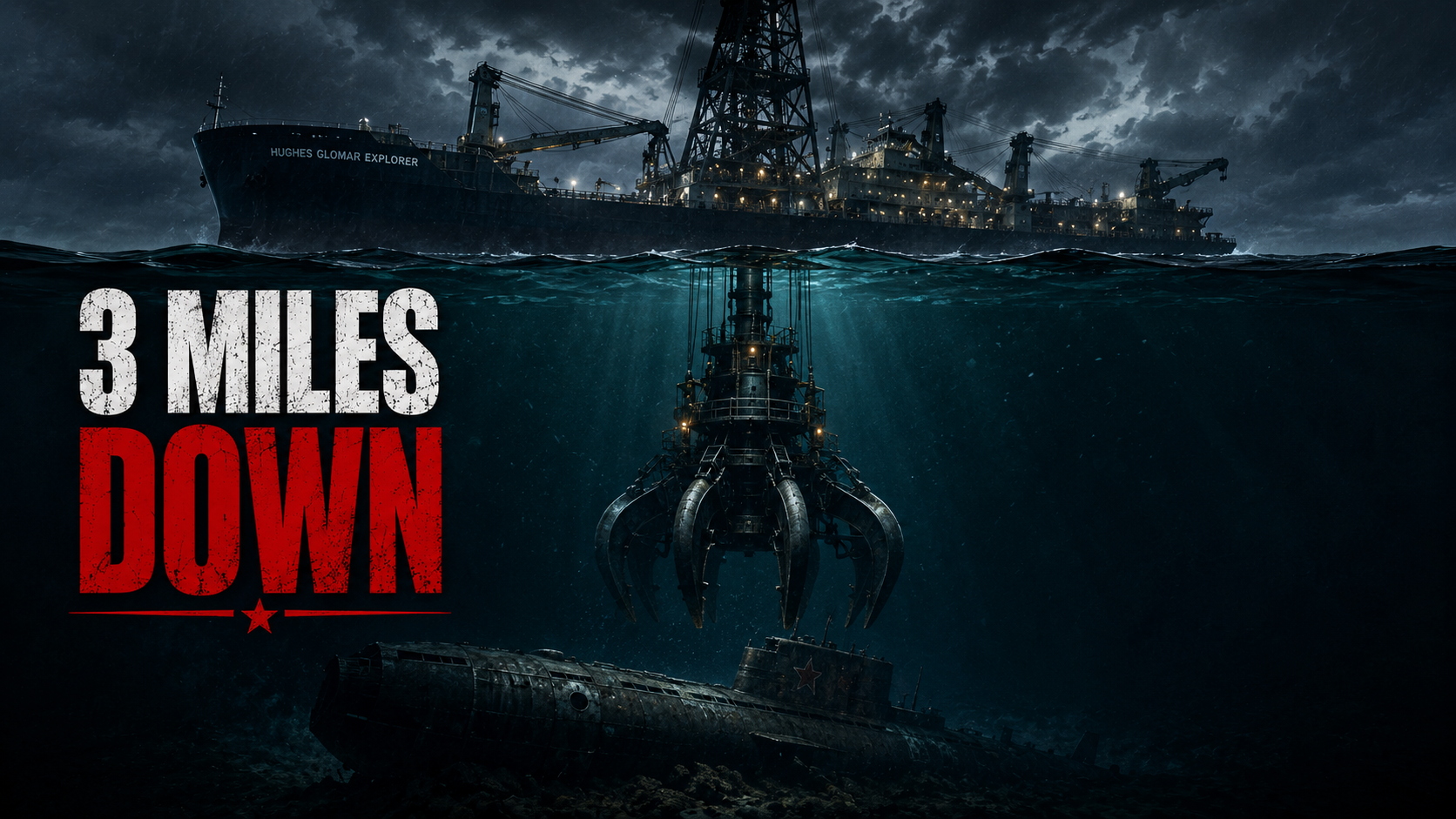
A capture vehicle of extraordinary scale a mechanical steel claw the CIA nicknamed Clementine engineered to descend three miles through the ocean, close around the K-129’s hull, and lift it upward while the ship held perfectly stationary above. At the center of the Glomar Explorer’s hull was a moon pool a massive internal opening through which the entire lifting operation could be conducted in complete secrecy, invisible to any Soviet vessel or aircraft passing above.
The capture vehicle was built by Lockheed’s Skunk Works the same classified facility that had produced the U-2 spy plane and the SR-71 Blackbird. Hundreds of engineers and contractors worked across multiple sites, most of them told only what they needed to know, which was almost nothing. The compartmentalization was absolute. The cover was intact.
By the summer of 1974, the Glomar Explorer was ready. She departed Long Beach, California, with a crew of over 170 men CIA officers, naval specialists, and cleared contractors, all operating under strict secrecy, all sailing toward a patch of open Pacific Ocean that looked like nothing and contained everything. Almost immediately after the ship took position above the wreck site, Soviet naval vessels arrived to investigate.
Two Soviet ships pulled directly alongside. The crew of the Glomar Explorer, following their cover story without a visible crack, invited the Soviet sailors aboard for a tour. The Soviets walked the decks. They examined the mining equipment. They saw exactly what they were meant to see. They left. Three miles below their hulls, Clementine was already being prepared for descent.
The operation that followed pushed human engineering to its absolute edge. The capture vehicle was lowered on a pipe string assembled section by section through the ship’s massive derrick a mechanical spine growing downward through 16,500 feet of black ocean, taking hours to reach the bottom.
Deep-sea cameras relayed images from the wreck site to the control room above grainy, flickering, black-and-white images of the K-129 lying exactly as she had fallen six years earlier. The men watching those screens understood the weight of what they were looking at. They were not just running a salvage operation. They were reaching into the grave of ninety-eight men. And they were doing it in the name of national security, in the dark, three miles below the world.
Clementine settled around the K-129’s hull. The lift began. For hours, the pipe string was recovered segment by segment, the capture vehicle rising through three miles of darkness with the submarine in its grip. The Glomar Explorer’s dynamic positioning system fought continuously to hold the ship stationary against ocean currents. The tension in the control room was physical, suffocating. Everything that had been spent the money, the years, the engineering genius, the elaborate deception came down to this. The pipe string rising, foot by foot, mile by mile. And then it broke.
Without warning, multiple structural arms of the Clementine failed under the catastrophic stress of the load. The K-129 broke apart. The section containing the nuclear ballistic missiles the primary intelligence target tore free and plummeted back into the abyss. It fell all three miles back to the ocean floor. It was gone again. Permanently. Irretrievably.
What remained in Clementine’s grip was the forward section of the submarine. The CIA brought it up through the moon pool and into the hidden interior of the Glomar Explorer. Inside, they found the bodies of six Soviet sailors, preserved by the cold and pressure of the deep ocean. What happened next was quietly extraordinary. The CIA conducted a full formal naval burial ceremony for the six men, filmed in its entirety, conducted with complete military dignity.
Years later, after the Soviet Union had collapsed, the CIA Director delivered a copy of that footage personally to Russian President Boris Yeltsin. The men who had died in service to the Soviet state received a burial with full military honors from the nation they had trained their entire careers to fight against. It was perhaps the most human moment of the entire Cold War.
The intelligence recovered from the forward section remains partially classified to this day. Nuclear warheads were not in the recovered portion. But technical materials, equipment, and documents provided American analysts with intelligence they had never previously accessed. Even in partial success, the CIA considered AZORIAN a triumph.
Then a burglar broke into a Howard Hughes office in Los Angeles and stole documents that described the operation. The story leaked. In February 1975, it appeared in print. The cover was blown. Project AZORIAN entered the public record, and the Soviet government which had spent months watching the Glomar Explorer with undisguised curiosity finally understood what had been happening beneath their patrol routes.
When journalists pressed the CIA for confirmation, the Agency’s response created a phrase that has lived in legal and governmental language ever since. The CIA could neither confirm nor deny the existence of the program. It was so precisely, so elegantly constructed to reveal nothing while appearing to say something that it entered the lexicon permanently. To this day, any official government refusal to acknowledge a classified program is called a Glomar response named for the ship, the mission, and the lie that almost held forever.
Project AZORIAN was officially acknowledged by the CIA in 2010. The full accounting of what was recovered remains incomplete. And somewhere in the North Pacific Ocean, three miles down in permanent darkness, the rest of the K-129 still lies exactly where she fell in 1968. The missiles are still there. The remaining sailors are still there. Undisturbed. In the cold. In the dark.
The heist the world was never meant to know about. The secret that held for fifty years. And one of the most extraordinary operations ever attempted by any intelligence service in the history of the modern world.