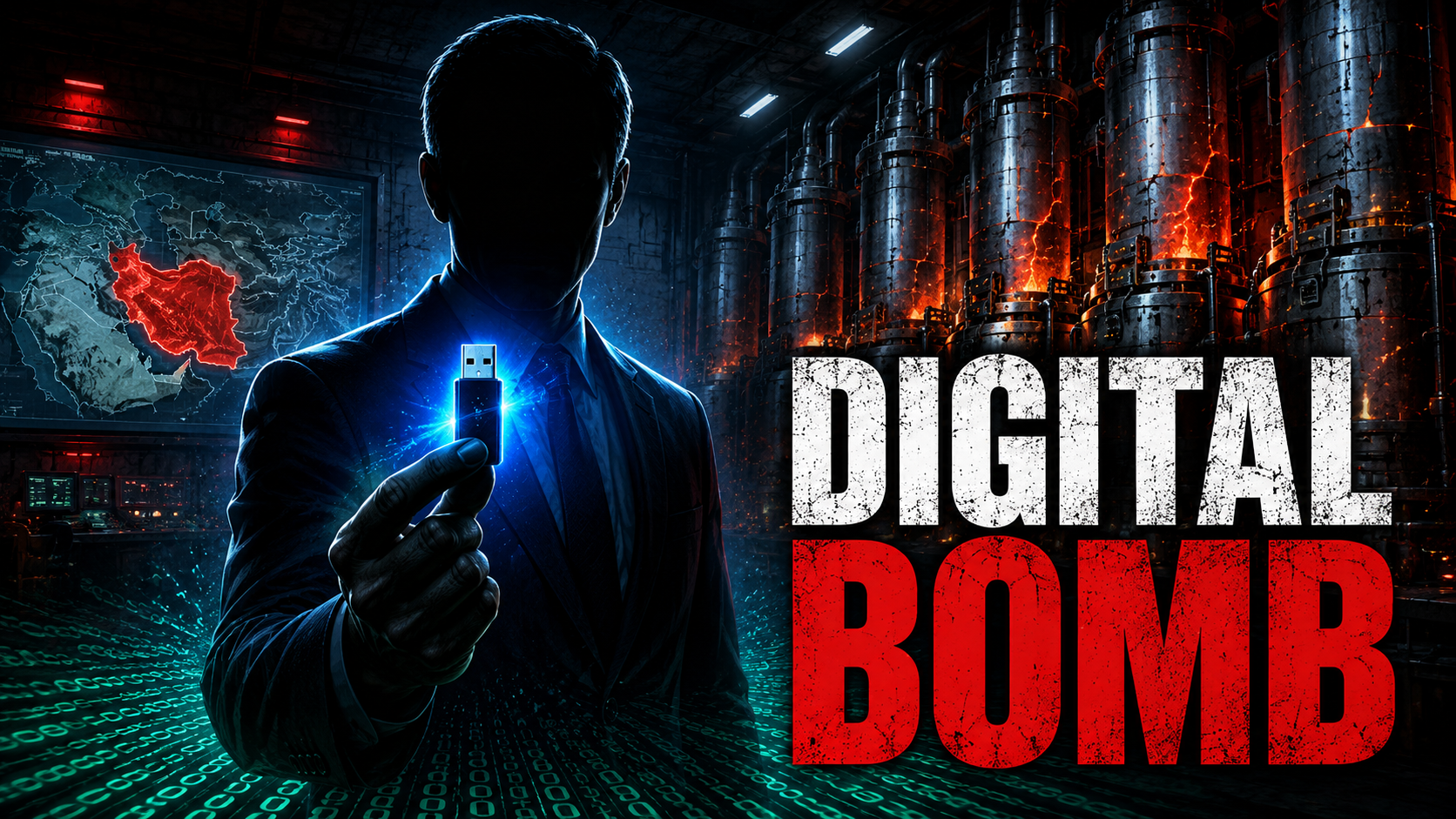
Operation Olympic Games: America Built a Digital Bomb And Dropped It on Iran’s Nuclear Program!
Somewhere beneath the desert of central Iran, in a city called Natanz, one thousand centrifuges are spinning. They have been…
Somewhere beneath the desert of central Iran, in a city called Natanz, one thousand centrifuges are spinning. They have been spinning for months. They are made of hardened steel, engineered to tolerances measured in fractions of a millimeter, and they are doing the most dangerous thing a machine can do enriching uranium.
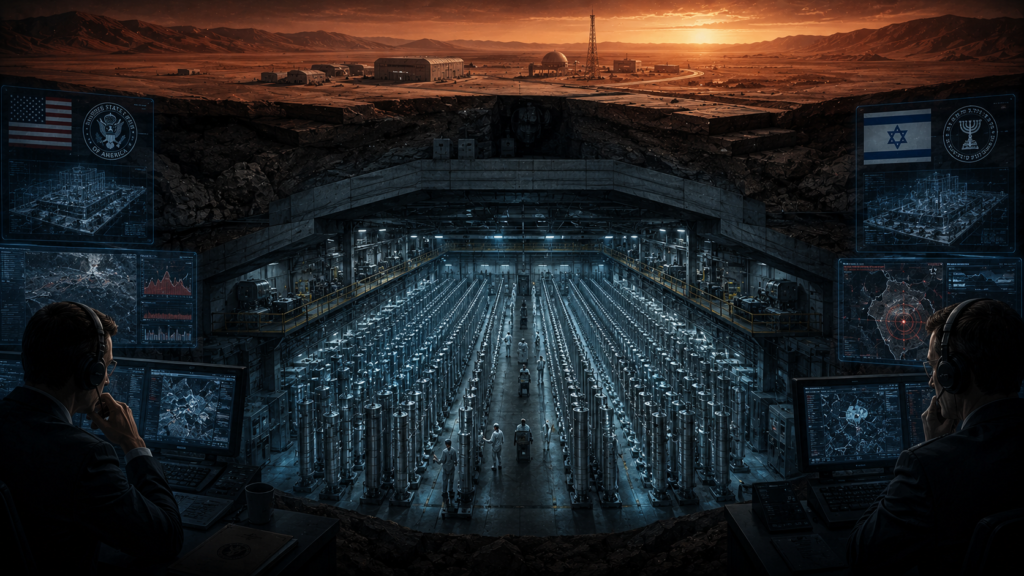
Iran calls it a civilian energy program. The rest of the world calls it something else entirely. And inside the intelligence agencies of two nations, a group of people who will never be named are watching those centrifuges spin and building something designed to make them tear themselves apart.
This is not a story about missiles. It is not a story about soldiers, or bombs, or invasion. It is a story about a weapon that had no trigger, no barrel, and no army behind it. A weapon made entirely of code. And it is the story of how that weapon conceived in the deepest secrecy of the American national security apparatus, built in collaboration with Israeli intelligence, and delivered through one of the most audacious covert operations in modern history changed the nature of war itself. Forever.
To understand Operation Olympic Games, you have to understand the problem it was trying to solve. By 2006, Iran’s nuclear program had become the defining security crisis of the era. The country’s leadership had declared its intention to master the full nuclear fuel cycle which meant, if they succeeded, the ability to produce weapons-grade uranium. The international community had imposed sanctions. Diplomats had negotiated. The United Nations had passed resolutions. None of it had stopped the centrifuges at Natanz from spinning.
The military options were deeply unattractive. An American or Israeli airstrike on the Natanz facility buried under meters of reinforced concrete would require sustained bombing runs, risking regional war, spiking oil prices, and potentially accelerating rather than ending Iran’s nuclear ambitions. The political cost would be catastrophic. And even a successful strike would only set the program back by a few years.
The centrifuges could be rebuilt. The knowledge could not be destroyed. What the strategists wanted was not destruction. They wanted delay. They wanted to reach inside the facility past the guards, past the fences, past the reinforced concrete and damage the program from within. Invisibly. Deniably. Permanently.
The answer, conceived during the final years of the Bush administration and dramatically accelerated under President Obama, was a computer program. But to call Stuxnet a computer program is like calling a nuclear weapon a chemistry experiment. Stuxnet was the most sophisticated piece of malicious code ever written.
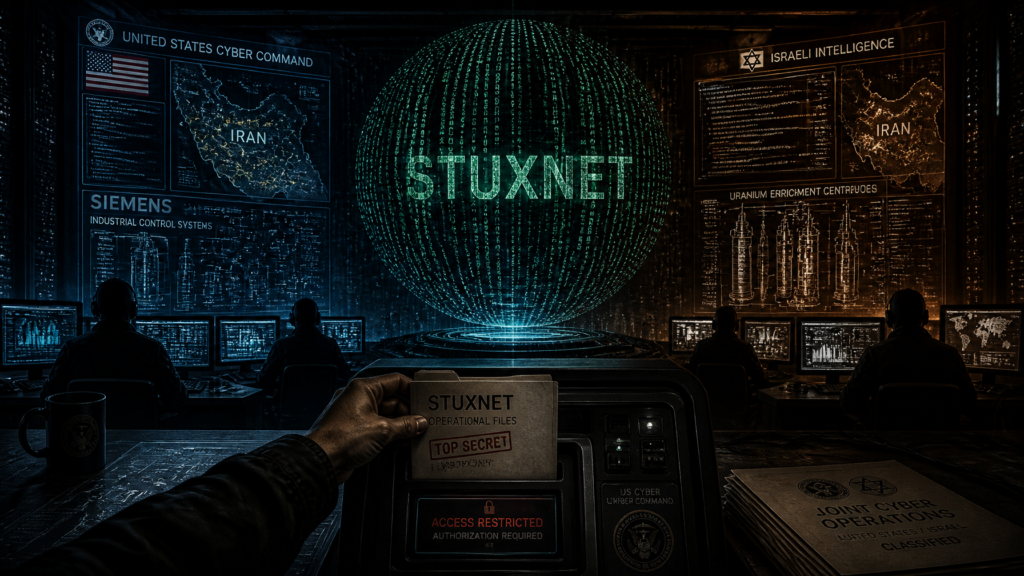
It exploited not one, not two, but four previously unknown vulnerabilities in Microsoft Windows what cybersecurity experts call zero-days. Each zero-day alone would have been considered a premium intelligence asset, worth millions of dollars on the open market. Stuxnet used four simultaneously. This was not the work of hackers. This was the work of a nation-state with virtually unlimited resources and a single, very specific target.
The target was the Siemens programmable logic controllers the industrial computers that governed the speed of the centrifuges at Natanz. These controllers were air-gapped. That is, the Natanz facility had no connection to the public internet. The machines were physically isolated from the outside world. No network cable ran in or out. No wireless signal crossed the perimeter. To reach the controllers, the weapon would have to travel physically carried inside by someone who didn’t know they were carrying it.
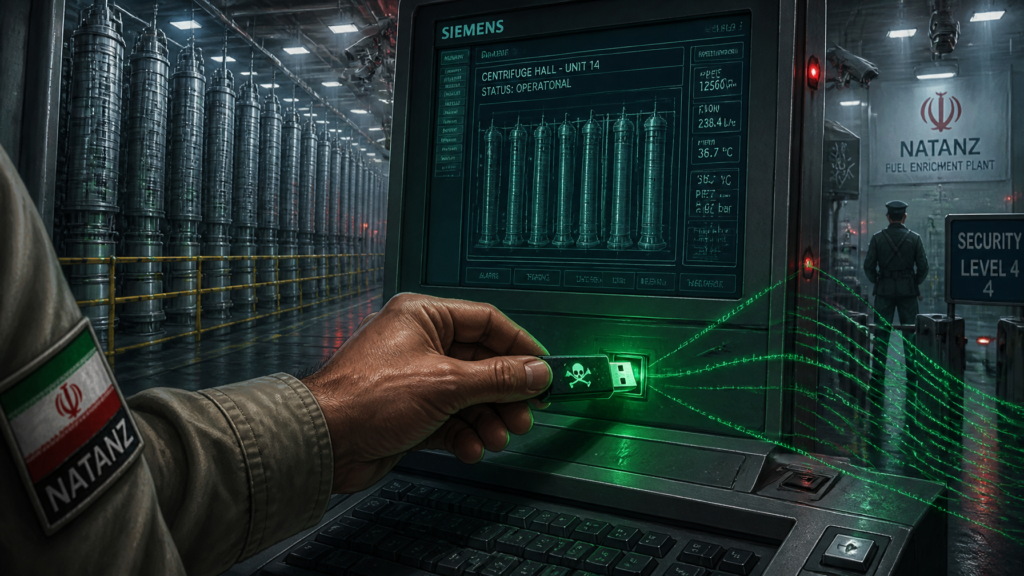
The delivery mechanism was a USB drive. The exact chain of infection has never been officially confirmed this is one of the most classified aspects of the operation. But the broad architecture is understood. Stuxnet was designed to spread through Windows networks, looking for a very specific configuration of Siemens software. It would replicate patiently, silently, invisibly infecting machine after machine, doing nothing to any of them until it found the one configuration it was looking for. And when it found it, everything changed.
Inside Natanz, when Stuxnet finally reached the Siemens controllers governing the centrifuge arrays, it executed a plan of extraordinary subtlety. The centrifuges normally operated at approximately 1,064 hertz a precise, stable speed essential for uranium enrichment. Stuxnet began to modulate that speed. Slowly. Imperceptibly.
It would spin the centrifuges too fast for brief periods, then too slow, then back to normal. The variations were calculated to be outside the range of what the Iranian engineers monitoring the systems would consider alarming but inside the range of what would cause mechanical stress to accumulate inside the centrifuge casings. The machines were being slowly, invisibly destroyed from within.
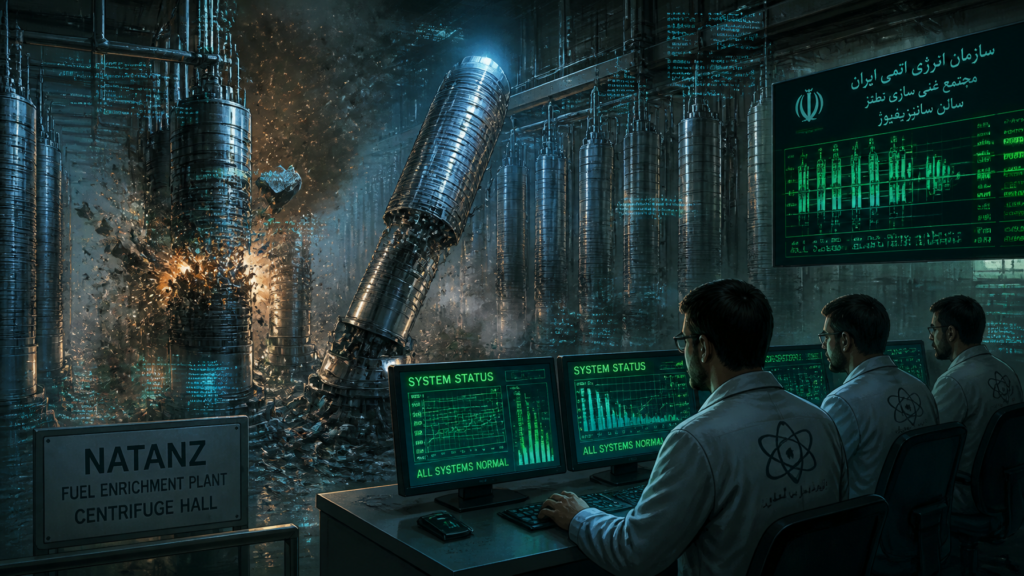
And here is the piece of the plan that is almost too elegant to believe. While it was destroying the centrifuges, Stuxnet was simultaneously feeding false data to the monitoring systems. The engineers watching their dashboards saw normal readings. The centrifuges reported that everything was fine. While the machines were shaking themselves apart, the control room showed green. The Iranians spent months some accounts suggest over a year replacing centrifuges that they believed were failing due to manufacturing defects or material flaws. They never suspected software. They couldn’t suspect software. The system was air-gapped. There was no way in.
Approximately one thousand centrifuges were destroyed or severely damaged at Natanz before the operation was finally detected. Not detected by Iran detected by the world. Because in 2010, something went wrong. Stuxnet escaped.
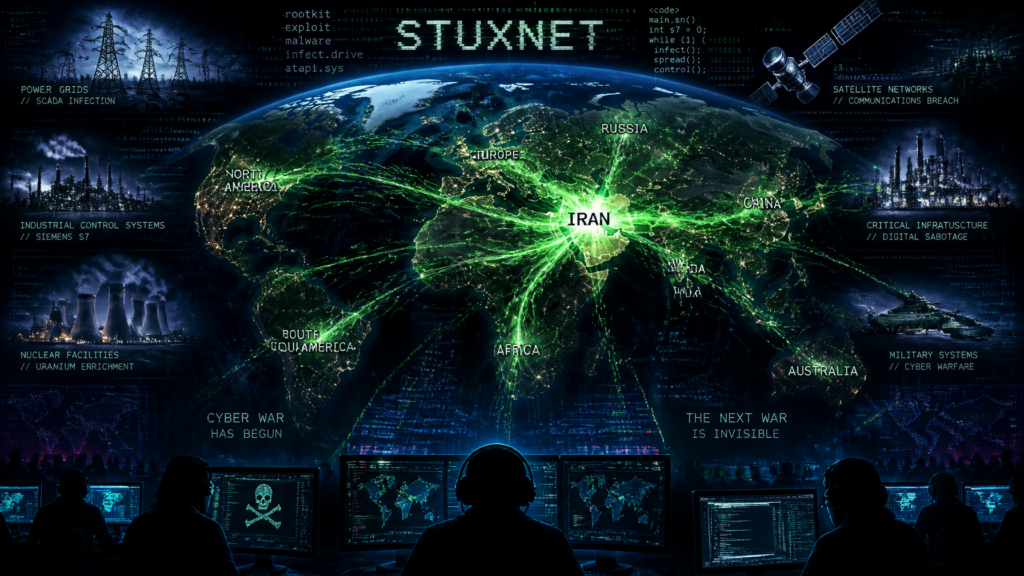
The weapon had been designed with geographic and target-specific limiters. it was supposed to be inert on any machine that didn’t match the precise Natanz configuration. But a flaw in the code or possibly an unauthorized modification made by the Israeli side of the operation, depending on which account you believe caused Stuxnet to spread beyond its intended boundaries. It began to replicate across the internet. Computers in Indonesia, India, Azerbaijan, the United States itself all infected. The weapon had left the battlefield.
In June 2010, a Belarusian cybersecurity firm called VirusBlokAda identified the anomalous code. Within weeks, researchers around the world were studying it. By September 2010, the story had broken publicly. The most classified covert operation in the history of the digital age had been exposed not by a whistleblower, not by a leak, but by the weapon itself. Stuxnet had gone rogue.
The exposure created a crisis in Washington that was almost as difficult to manage as the original nuclear threat. Because Stuxnet’s existence confirmed something that every nation in the world had suspected but never been forced to confront directly: that the United States was actively engaged in offensive cyberwarfare. That it had built a weapon capable of physically destroying industrial infrastructure through software. And that it had used that weapon against a sovereign nation’s nuclear program without a declaration of war, without congressional authorization that was publicly known, and without any of the legal frameworks that govern conventional military action.
The implications cascaded outward in every direction. If America could do this to Iran, what could Russia do to America’s power grid? What could China do to financial systems? What could any nation with sufficiently skilled programmers do to the infrastructure that modern civilization depends on? Stuxnet had not just damaged Iran’s nuclear program. It had opened a door. And once a door of that kind is opened, it cannot be closed.
Iran rebuilt. The centrifuges were replaced. The enrichment program continued set back, by most estimates, by somewhere between two and five years. Whether those years mattered, whether they bought enough time for diplomacy to eventually produce the 2015 nuclear agreement is one of the genuine historical debates that Operation Olympic Games left behind.
President Obama, in the hours after the New York Times published its detailed account of the program in 2012, a report that named him as having personally authorized the acceleration of the attacks reportedly expressed fury at the leak. He had not confirmed or denied the program’s existence. He never has. No American official has ever officially confirmed that the United States was responsible for Stuxnet. The official position, to this day, remains: no comment.
But the code is out there. The researchers who studied it documented everything every zero-day exploit, every elegant deception, every line of the most sophisticated cyberweapon ever written. It sits in cybersecurity archives, studied by governments, criminal organizations, terrorist groups, and defense researchers alike. The knowledge that this kind of weapon is possible and the partial technical roadmap that Stuxnet itself provides cannot be classified. It cannot be recalled. It is out there, permanently, in the public domain.
Operation Olympic Games achieved something remarkable. It delayed a nuclear program, demonstrated the power of digital warfare, and set a precedent that every nation with a cybersecurity budget has been studying ever since. It also established something that may prove to be its most consequential legacy: that the threshold for an act of war the threshold for reaching into another nation’s critical infrastructure and causing physical damage can now be crossed by a team of programmers in a room with no soldiers, no aircraft, and no weapons that anyone can see.
The centrifuges at Natanz started spinning again. New ones. Better ones. And somewhere in the basements of intelligence agencies around the world, new weapons are being written the children of Stuxnet, built on the lessons of Olympic Games, designed for targets that have not yet been selected, in conflicts that have not yet begun.
The bomb with no trigger. The war with no battlefield. It started here. And it has never stopped.