
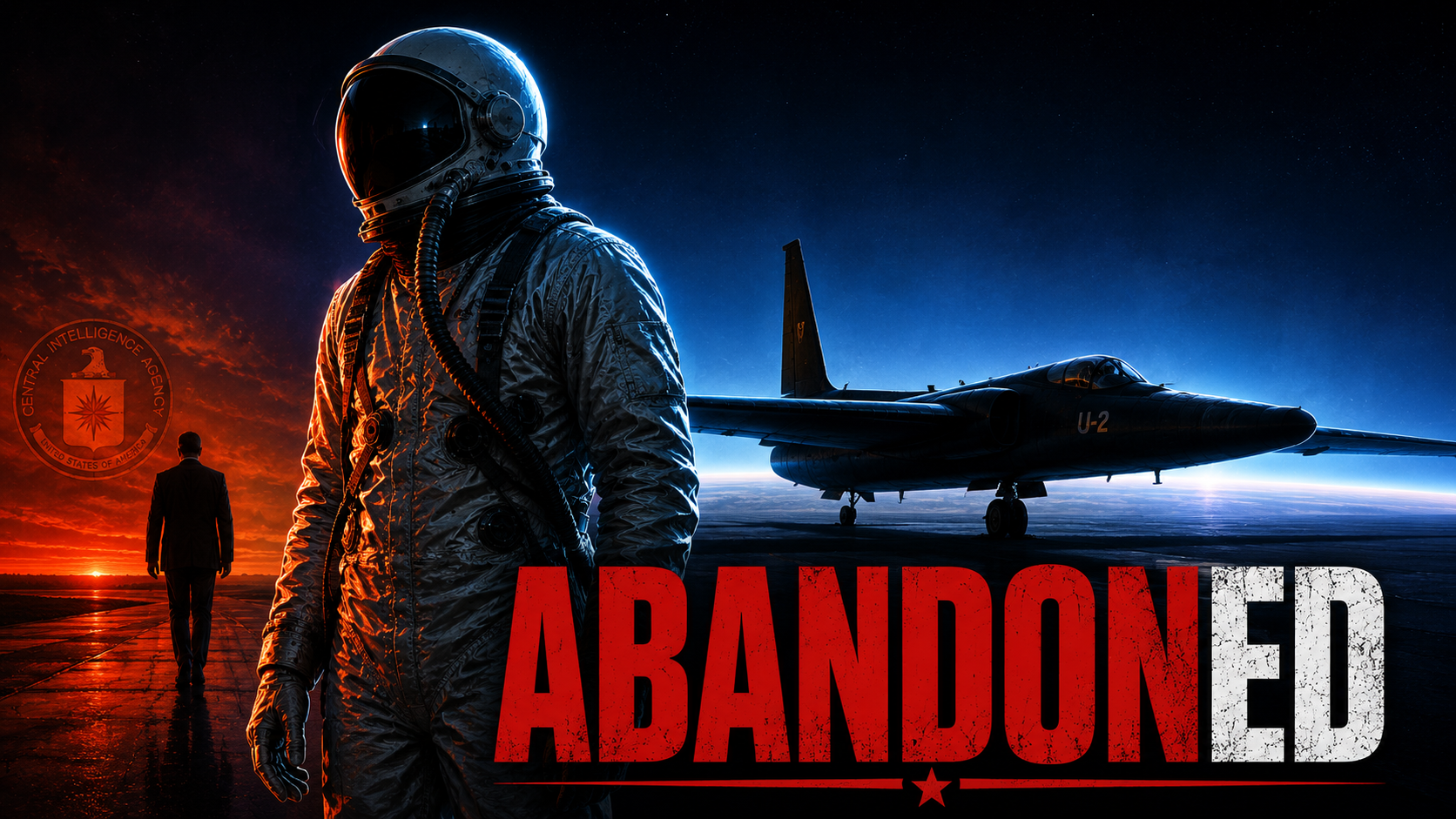
U-2 Spy Plane Program: The Most Dangerous Flight in History And the Pilot America Abandoned
On the morning of May 1st, 1960, a man climbed into a cockpit at a secret airbase in Peshawar, Pakistan,…
On the morning of May 1st, 1960, a man climbed into a cockpit at a secret airbase in Peshawar, Pakistan, and prepared to fly alone across the entire Soviet Union. He was not a soldier. He was not a general. He was a civilian pilot on a government contract, paid well, told very little, and given something that no amount of money can adequately compensate for a poison pin. A hollow silver dollar containing a tiny needle coated in shellfish toxin, designed to kill within seconds. If he was captured, he was expected to use it. The United States government, which had sent him into the most dangerous airspace on Earth, officially did not know who he was. Officially, he did not exist. Officially, the mission he was flying had never been authorized.
His name was Francis Gary Powers. And what happened to him on that mission what his government did to him before, during, and after the worst day of his life is one of the most quietly shameful stories the Cold War produced.
To understand how Francis Gary Powers ended up alone at seventy thousand feet over the Soviet Union, you have to understand the machine that put him there and the fear that built it. By the early 1950s, the United States intelligence community was operating in a state of controlled panic. The Soviet Union had nuclear weapons. It had long-range bombers. It was building ballistic missiles at a pace that American analysts could not accurately measure because they could not see inside Soviet territory.
The borders were sealed. The airspace was forbidden. The intelligence picture was almost completely dark. America was making its most critical strategic decisions how many bombers to build, how many missiles to fund, where to position its defenses based on estimates that were little better than educated guesses. In the nuclear age, educated guesses were not good enough.
The answer was conceived in the corridors of the CIA and the Eisenhower White House and handed to a man named Kelly Johnson at Lockheed’s legendary Skunk Works facility in Burbank, California. The brief was extraordinary in its ambition and its simplicity: build an aircraft that can fly higher than any Soviet air defense can reach, carry cameras capable of photographing military installations from that altitude, and do it before anyone can stop it. Johnson took the brief, took the contract, and in eight months produced something that had never existed before. The U-2 a jet aircraft with the wingspan of a small airliner, the fuselage of a pencil, and the operational ceiling of an angel.
The U-2 could cruise at altitudes above seventy thousand feet more than thirteen miles above the Earth’s surface. At that height, the sky above the cockpit is nearly black. The curvature of the Earth is visible at the horizon. The pilot sits in a full pressure suit because without it, his blood would boil. The aircraft is so light, so fragile, so precisely engineered for altitude that it cannot safely land without a crew of chase cars chasing it down the runway to catch the wingtip before it strikes the ground. It is, in almost every conventional sense, not a practical aircraft. But at seventy thousand feet in 1956, nothing the Soviet Union possessed could touch it.
The first overflights began in the summer of 1956. The results were staggering. U-2 cameras operating from the edge of space could resolve objects on the ground as small as a few feet across. Airfields, missile test sites, bomber bases, naval facilities all of it suddenly visible, photographable, countable. The intelligence haul from the first missions transformed American strategic planning overnight. The terrifying estimates of Soviet military power the numbers that had driven American defense spending to extraordinary levels began to look very different when measured against actual photographic evidence.
But there was a problem. A problem that the Eisenhower administration chose to ignore because the intelligence was too valuable and the program was too productive to stop. The Soviets knew the U-2 was flying over their territory. Soviet radar tracked every mission from the moment the aircraft crossed the border. Soviet fighters were scrambled on every overflight.
They simply could not reach the U-2 at altitude their interceptors ran out of ceiling thousands of feet below. But they were tracking. They were recording. They were, in the words of one CIA official who later reflected on the period, acutely and furiously aware that their most sensitive military secrets were being photographed by an aircraft they could not shoot down.
Khrushchev made a political calculation. He did not publicly protest the overflights, because to do so would be to admit that the Soviet Union which presented itself to its own people and the world as a military superpower of the first order could not defend its own airspace. He swallowed the humiliation. And he waited. Because Soviet engineers were working on something. A surface-to-air missile system called the SA-2 Guideline designed specifically to kill aircraft at the altitudes where the U-2 operated. And by the spring of 1960, it was ready.
Francis Gary Powers had been flying U-2 missions since 1956. He was good at the work careful, professional, technically skilled. He understood the risks abstractly, the way people understand risks that have never yet materialized. On May 1st, 1960, he took off from Peshawar on a mission designated Operation Grand Slam a full crossing of Soviet territory from Pakistan to Norway, photographing a comprehensive list of high-priority targets including the Baikonur Cosmodrome and multiple ICBM sites. It was one of the most ambitious and most sensitive overflights ever planned. Fourteen countries were watching the outcome. A summit meeting between Eisenhower and Khrushchev was scheduled for Paris in two weeks.
Over Sverdlovsk deep in the Soviet interior, more than a thousand miles from the nearest border an SA-2 missile detonated close enough to the U-2 to destroy its tail section and send the aircraft into an uncontrolled dive. Powers survived the initial impact.
He could not use the aircraft’s self-destruct mechanism the g-forces of the spinning aircraft pinned him against the cockpit. He bailed out at around fifteen thousand feet and parachuted to the ground, where Soviet citizens and then Soviet military personnel were waiting for him. He had the poison pin. He chose not to use it. That decision entirely reasonable, entirely human — would be used against him for years.
What happened in Washington in the hours and days after Powers disappeared tells you almost everything you need to know about how the Eisenhower administration handled the crisis it had spent four years creating. The initial assumption reasonable but catastrophically wrong was that Powers was dead, the aircraft destroyed, and the Soviets would have no usable evidence.
So the cover story went out: a NASA weather research aircraft had reported oxygen equipment trouble while flying over Turkey and the pilot had gone missing. The aircraft might have accidentally drifted into Soviet airspace.
It was a lie carefully constructed to be plausible and Khrushchev let it stand for four days. On May 5th, he appeared before the Supreme Soviet and announced that the Soviet Union had shot down an American spy plane. He waited. The Americans repeated the cover story. On May 7th, Khrushchev revealed that they had the pilot alive, in custody, talking. They had the aircraft wreckage, the cameras, the film. They had the poison pin. They had Powers’s identity documents. They had everything. The cover story collapsed in real time, in public, before the entire world.
Eisenhower faced a choice that no president should face: admit the program, accept responsibility, and absorb the political damage or continue lying and be proven a liar regardless. He admitted it. For the first time in history, a sitting American president publicly acknowledged that his government had been conducting espionage against another nation from its own sovereign airspace.
The Paris summit collapsed before it began. Khrushchev walked out. The last genuine diplomatic opportunity of the early Cold War a moment when both sides had reasons to de-escalate evaporated because of a mission that should, by every operational assessment, have been postponed.
Powers was tried in Moscow in August 1960. The trial was a spectacle a carefully staged Soviet public relations exercise designed to extract maximum humiliation from the United States. Powers was convicted of espionage and sentenced to ten years three in prison, seven in a labor camp. He conducted himself with considerable dignity throughout, saying nothing that could have been used to damage American intelligence programs beyond what the Soviets already knew. That restraint went unacknowledged by his government.
In America, the reaction to Powers was something between confused and contemptuous. Why was he alive? Why hadn’t he used the poison pin? Why hadn’t he activated the aircraft’s self-destruct? Editorial writers and anonymous government officials briefed to shift blame away from the program’s architects suggested that Powers had somehow failed. That a braver man, a better pilot, a more committed American, would have died rather than been captured. It was a grotesque piece of institutional cowardice, and it followed Powers for the rest of his life.
He was exchanged on February 10th, 1962, on the Glienicke Bridge in Berlin the spy bridge, the bridge that connected East and West across the fault line of the Cold War. Traded for Rudolf Abel, a Soviet intelligence officer who had been arrested in New York in 1957. The exchange was conducted in silence and cold air, two figures walking toward each other across a bridge as their handlers watched from opposite ends. Powers walked back into American custody. He was debriefed extensively by the CIA, which concluded that he had behaved properly under the circumstances. He was not, however, publicly cleared. He was quietly given a certificate of appreciation and returned to civilian life.
He spent years trying to rebuild a reputation that his government had quietly destroyed. He wrote a book. He gave interviews. He told his story with a specificity and a restraint that spoke of a man who had processed something enormous and was trying to communicate it accurately rather than dramatically. He became a helicopter traffic reporter in Los Angeles a career that required skill and calmness and offered nothing like the adrenaline of flying alone at the edge of space. He died in a helicopter crash in 1977, at the age of forty-seven, when his aircraft ran out of fuel over Los Angeles.
The CIA awarded him the Director’s Medal posthumously in 2000. Forty years after the mission. Twenty-three years after his death. The medal was accepted by his son.
The U-2 program continued after Powers. It flies today the same basic airframe, updated electronics, still operating at the edge of space, still doing the work that no satellite can fully replicate because a satellite follows a fixed orbit and a U-2 can be directed. The aircraft that was supposed to be untouchable is still flying, more than sixty years after it was built in eight months in a California hangar.
But the story of the program is inseparable from the story of the man it consumed and discarded. Francis Gary Powers flew the mission he was paid to fly, survived the capture he was equipped to avoid, endured the imprisonment he was told would never happen, and returned to a country that spent twenty years treating his survival as an inconvenience. He was not a hero in the way that word is commonly used dramatic, celebrated, publicly honored in real time. He was something quieter and in some ways harder: a man who did exactly what was asked of him, was punished for surviving it, and spent the remainder of his life simply trying to set the record straight.
The record, eventually, agreed with him. It just took longer than it should have. It always does.
3 Comments