
Project DARPA: They Built the Internet, Stealth Aircraft, and GPS – Then Classified the Programs For Decades
There is a building in Arlington, Virginia that most people drive past without a second thought. No prominent signage. No…
There is a building in Arlington, Virginia that most people drive past without a second thought. No prominent signage. No visible security apparatus beyond what any government facility might display. No crowds of scientists in white coats visible through glass lobbies. From the outside, it could be an insurance company, a mid-level federal agency, a bureau that processes forms and manages modest budgets. Inside, in the decades since its founding, the people who have worked there have invented the internet, created stealth aircraft technology, developed the global positioning system that guides every smartphone and every missile on Earth, pioneered drone warfare, and produced a catalogue of technologies so far ahead of their time that their existence was classified for years sometimes decades after they first flew, first fired, or first connected.
The building belongs to the Defense Advanced Research Projects Agency. DARPA. And the story of what it has built in secret, what it has classified, and what it has eventually released into a world that had no idea it was coming is one of the most consequential and least understood stories in modern American history.
To understand DARPA, you have to understand the particular institutional panic that created it. On October 4th, 1957, the Soviet Union launched Sputnik into orbit. A metal sphere the size of a beach ball, beeping a radio signal that amateur receivers around the world could detect, circling the Earth every ninety-six minutes. The technological and psychological shock to the United States was profound and immediate. The most powerful nation on Earth had been beaten into space by its adversary.
The question that followed Sputnik into every government office, every military briefing room, and every scientific institution in America was the same: how did we not see this coming? How did a nation with America’s resources, America’s universities, America’s industrial base, fail to anticipate that the Soviet Union was capable of this? And more urgently: what else might they be capable of that we are not anticipating?
President Eisenhower’s answer was DARPA created in February 1958, seven months after Sputnik, with a mandate that was extraordinary in its breadth and its deliberate vagueness. DARPA’s mission was to prevent technological surprise. To fund research so far ahead of the current state of the art that no adversary could develop a capability that American scientists had not already considered, explored, and in many cases already built.
The agency was given a budget that was large, relatively unaccountable by normal government standards, and deliberately insulated from the short-term thinking that drives most federal spending. DARPA did not have to show results next year. It did not have to produce a deployable weapon on a congressional timeline. It was given the rarest thing in government: permission to think as far ahead as the science would allow, fund the ideas that seemed most impossibly ambitious, and classify what it found until the military was ready to use it.
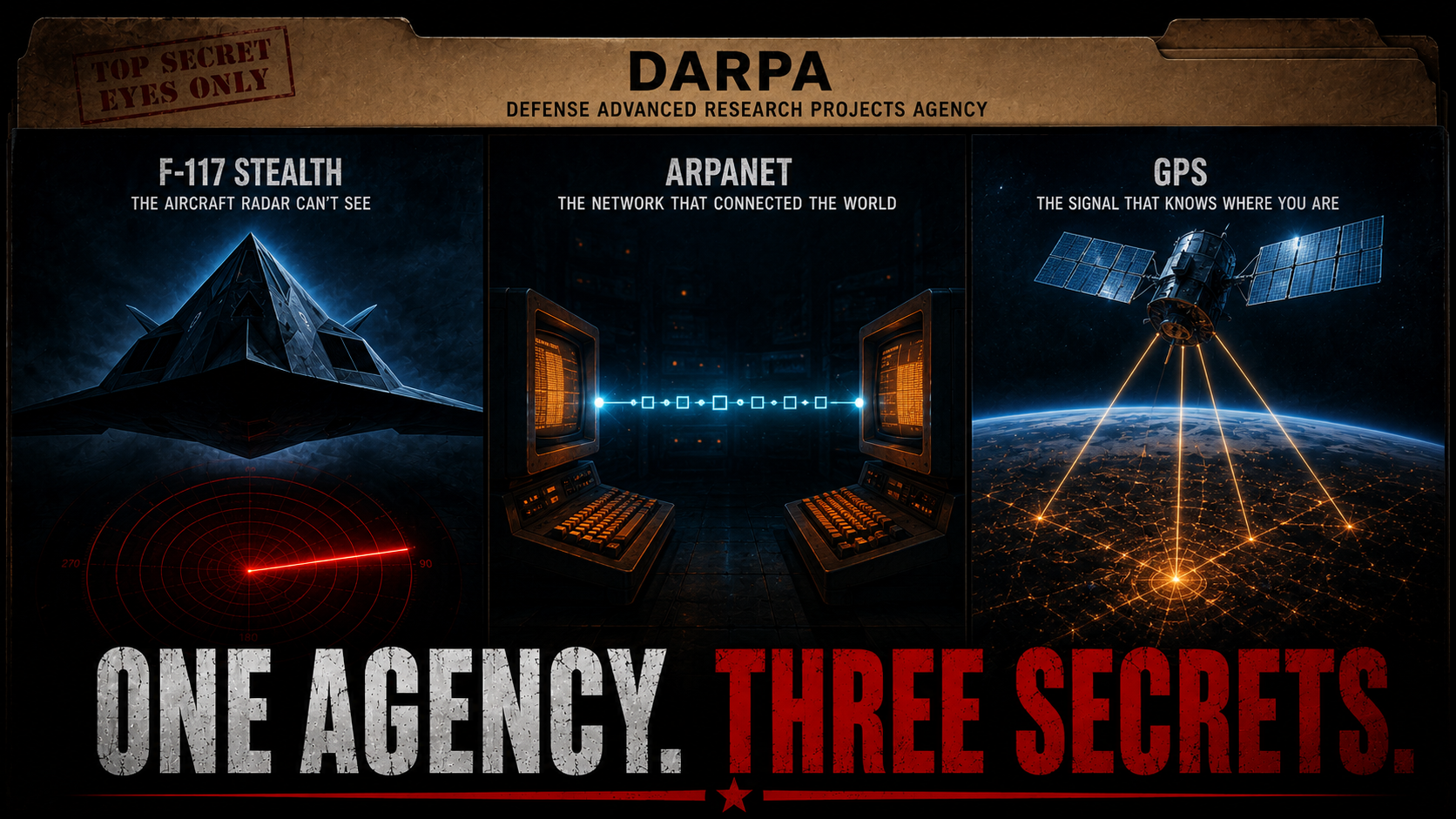
The first and perhaps most consequential of DARPA’s eventually-declassified projects was ARPANET the network that became the internet. In the mid-1960s, DARPA funded research into a concept called packet switching a method of transmitting data by breaking it into discrete packets, routing each packet independently through a network, and reassembling them at the destination. The concept was theoretical, ambitious, and of immediate interest to the Defense Department, which needed communications systems that could survive a nuclear attack.
A conventional communications network one that relied on centralized switching stations was vulnerable: destroy the switches and the network dies. A packet-switched network had no center. There was nothing decisive to destroy. The network routed around damage as automatically as water finds its way around an obstacle.
ARPANET went live in 1969, connecting four university research computers in California and Utah. The first message ever transmitted across it the word “login,” which crashed the receiving system after the first two letters was sent between UCLA and the Stanford Research Institute on October 29th, 1969. The military application was classified. The research was funded under black budget lines that did not appear in public appropriations documents.
The scientists who built it understood that they were creating something unprecedented. They had no way of knowing that they were laying the foundation for a global communications infrastructure that would eventually connect more than five billion people and fundamentally reshape every aspect of human civilization. DARPA had invented the future and classified it as a defense research project.
The stealth story begins in a DARPA study from 1974 a document with the bureaucratic title “Radar Cross Section” that contained a mathematical framework, developed by a team led by a physicist named Denys Overholser drawing on work by a Soviet scientist named Pyotr Ufimtsev, for calculating and minimizing the radar signature of an aircraft.
The mathematics showed that an aircraft built with specific angular geometries faceted surfaces arranged to deflect rather than reflect radar waves could be made effectively invisible to radar. The concept had been theoretically understood for years. What DARPA’s study provided was a computational method for designing an aircraft around the principle at an era when computing power was finally sufficient to handle the geometric complexity involved.
The program that followed was called Have Blue a DARPA-funded technology demonstrator contracted to Lockheed’s Skunk Works in 1975. Two Have Blue aircraft were built and flown at Area 51 in 1977 and 1978. They were ugly angular, faceted, deeply unstable aerodynamically, requiring fly-by-wire computer systems to remain controllable in flight. They were also, by every radar measurement taken against them, essentially invisible.
The Have Blue program was classified at the highest levels. It led directly to the F-117 Nighthawk the world’s first operational stealth aircraft which flew its first combat missions in 1989 over Panama, and its most famous missions over Baghdad in January 1991, striking targets that Iraqi air defenses could not detect and therefore could not protect. The Iraqis did not know the F-117 existed.
They had never seen a stealth aircraft. They fired their anti-aircraft systems at sounds and at radar returns that were not there. The aircraft they could not see dropped precision munitions through the ventilation shafts of buildings. DARPA had built a capability gap of fifteen years and hidden it so completely that the first time America’s adversaries encountered it, they had no context for understanding what was happening.
The GPS story is, in some respects, the most remarkable of all because it is the technology that has most completely escaped the classified world and embedded itself in the texture of ordinary life. The concept of using satellites to determine precise location on Earth’s surface was explored by DARPA beginning in the 1960s, following the success of early navigation satellite programs. The Defense Navigation Satellite System which became the Global Positioning System was developed through the 1970s under Pentagon funding with significant DARPA involvement in its technical architecture.
The first GPS satellite launched in 1978. The full constellation of twenty-four satellites was declared operational in 1993. Military GPS receivers, providing precision to within centimeters, were available to American forces throughout this period. Civilian GPS deliberately degraded by a feature called Selective Availability to a precision of around one hundred meters was made available to civilian users in 1983 following the shootdown of Korean Air Lines Flight 007 by Soviet fighters, which had strayed off course due to navigation error.
The full military precision of GPS centimeter-level accuracy, available to every smartphone user on Earth was released to the public when President Clinton ordered Selective Availability turned off in May 2000. The technology that DARPA and the Pentagon had developed, classified, partially released, and then fully released had by that point become so deeply integrated into civilian infrastructure aviation, shipping, agriculture, surveying, telecommunications network timing that turning it off would have been economically catastrophic. DARPA had invented a technology for military precision navigation and inadvertently created the backbone of the global civilian infrastructure system.
The drone program represents DARPA’s most direct contribution to the changing face of warfare in the post-Cold War era. Unmanned aerial vehicles aircraft operated without a pilot onboard had been explored by DARPA since the 1960s, initially as target drones and reconnaissance platforms. The Predator drone, which became the defining image of American counterterrorism operations in the post-September 11th era, traces its development lineage through a DARPA-funded program called Amber, developed by a company called Leading Systems in the late 1980s.
The concept a long-endurance, medium-altitude unmanned aircraft capable of persistent surveillance over a target area was funded by DARPA at a time when the Air Force had limited institutional interest in unmanned aviation. DARPA’s willingness to fund concepts that the conventional military services considered impractical or peripheral was precisely the institutional characteristic that made its contributions possible.
The Predator itself was developed by General Atomics from the Amber lineage and first flew in 1994. It was initially unarmed a surveillance platform only. The decision to arm the Predator with Hellfire missiles, transforming it from a reconnaissance asset into a strike platform, came after September 11th, 2001, and opened a chapter in the history of warfare whose implications are still being processed.
The armed drone changed the geography of conflict making it possible to project lethal force into remote and otherwise inaccessible areas with a level of precision and persistence that no previous weapons system had offered. DARPA had not specifically intended to create this capability. But the foundational technology it had funded, the institutional risk tolerance it had demonstrated, and the programmatic lineage it had established made the armed drone not just possible but, in retrospect, inevitable.
The classified programs that have not yet been declassified the current black projects whose existence is acknowledged only by their budget line items in classified congressional appropriations are by definition the part of the story that cannot be fully told. What can be said is this: the pattern of DARPA’s history suggests that the gap between what DARPA is working on today and what the public understands to be technologically possible is at least as large as the gap that existed in 1977 when Have Blue first flew invisible to radar over the Nevada desert, or in 1969 when the first packet of data crossed ARPANET. The agency’s institutional mandate has not changed. Its budget the portion that is publicly acknowledged runs to approximately four billion dollars annually. The classified portion does not appear in public documents.
Somewhere in that classified portion, the future is being built. It will be decades before the world knows exactly what has been built and what decisions, what conflicts, what technological shifts are being shaped by programs whose names do not yet appear in any document that any person without the appropriate clearance will ever read. The history of DARPA suggests that when those programs eventually become known when the declassification comes, as it always eventually does the world will discover that the future arrived earlier than anyone suspected.
That the technologies reshaping civilization were not born in the public research universities and corporate innovation labs where the public narrative of progress is written. They were born in classified programs, funded by a defense agency with permission to think further ahead than anyone else, built by people who could not tell anyone what they were building, and released into the world when the time and the classification review finally allowed.
DARPA built the internet. It built stealth. It built GPS. It built the drone. Each of these technologies arrived in the public world as if from nowhere a sudden capability that changed everything, whose origins were classified, whose development had been invisible, whose existence the world had not anticipated because the world had not been allowed to know it was happening.
The building in Arlington is still there. The work continues. And whatever is being built inside it right now whatever capability gap is being established, whatever future is being assembled in classified laboratories on classified timelines will arrive in the world the same way the others did. Quietly. Completely. And decades ahead of anything anyone expected.