Operation CORONA: The Spy Satellite That Photographed Every Soviet Secret And Was Hidden For 35 Years
There is a photograph. You cannot buy it. You cannot find it in any newspaper archive from the time it…
There is a photograph. You cannot buy it. You cannot find it in any newspaper archive from the time it was taken. For thirty-five years, it did not officially exist. It was taken from one hundred miles above the Earth, by a camera mounted inside a satellite that the American government publicly claimed was conducting peaceful scientific research. And what it showed what it proved, in cold black-and-white photographic detail may have done more to prevent nuclear war than any weapon, any treaty, or any diplomat in the entire history of the Cold War.
This is the story of Operation CORONA. The most classified intelligence program in American history. The program that put a spy camera into orbit, photographed the entire Soviet Union, and hid what it found for thirty-five years. And the story of how it almost never worked at all.
To understand why CORONA existed, you have to understand the particular terror of the late 1950s. The Soviet Union had detonated its first nuclear weapon in 1949. By the mid-1950s, it had hydrogen bombs. It had bombers capable of reaching American cities. And it had something that genuinely, viscerally terrified American military planners ballistic missiles. In 1957, the Soviets launched Sputnik, the world’s first artificial satellite, into orbit.
The same rocket technology that put a beeping metal sphere into space could put a nuclear warhead on Washington. America knew this. What America did not know what kept generals awake at night and drove intelligence analysts to the edge of professional desperation was how many missiles the Soviet Union actually had.
Intelligence estimates in the late 1950s spoke of a missile gap a terrifying disparity between Soviet nuclear capability and American defenses. Politicians seized on it. Presidential candidates debated it. The American public absorbed it as simple, frightening fact: the Soviets had more missiles. More bombers. More launch sites. America was behind, vulnerable, potentially outgunned in the war that everyone prayed would never start. But nobody actually knew. Nobody had seen the evidence. The Soviet Union was a closed country, eleven time zones wide, its military infrastructure hidden behind sealed borders and forbidden airspace. America was, in the most dangerous possible sense, flying blind.
The U-2 spy plane program had been America’s partial answer to that blindness. Flying at altitudes above Soviet air defenses, U-2 aircraft crossed Soviet territory photographing military installations, airfields, missile sites. It was dangerous, provocative, and technically illegal under international law. And it worked until May 1st, 1960, when a Soviet SA-2 surface-to-air missile found Francis Gary Powers at seventy thousand feet and brought him down over Sverdlovsk. The shootdown was a political catastrophe. The overflights stopped. America lost its eye in the sky at precisely the moment it could least afford to.
But CORONA had already been conceived. The idea was born from a question that sounds almost childishly simple in retrospect: if you cannot fly a plane over the Soviet Union, what about flying a camera above the Soviet Union? Not in a plane in a satellite. Above the atmosphere. Above any missile. Above any defense. A camera in orbit, looking straight down, photographing everything below it as the Earth rotated beneath.
The technical challenges were staggering. A camera capable of capturing useful imagery from one hundred miles up had never been built. The satellite carrying it had to survive the violence of a rocket launch, operate in the vacuum of space through temperature extremes of several hundred degrees in either direction, and function with mechanical precision that no space-based system had ever achieved. The film because this was 1958, and digital imaging existed nowhere had to come back to Earth. It had to survive atmospheric reentry without burning up. It had to be found, in the middle of the Pacific Ocean, before it sank or drifted beyond recovery range.
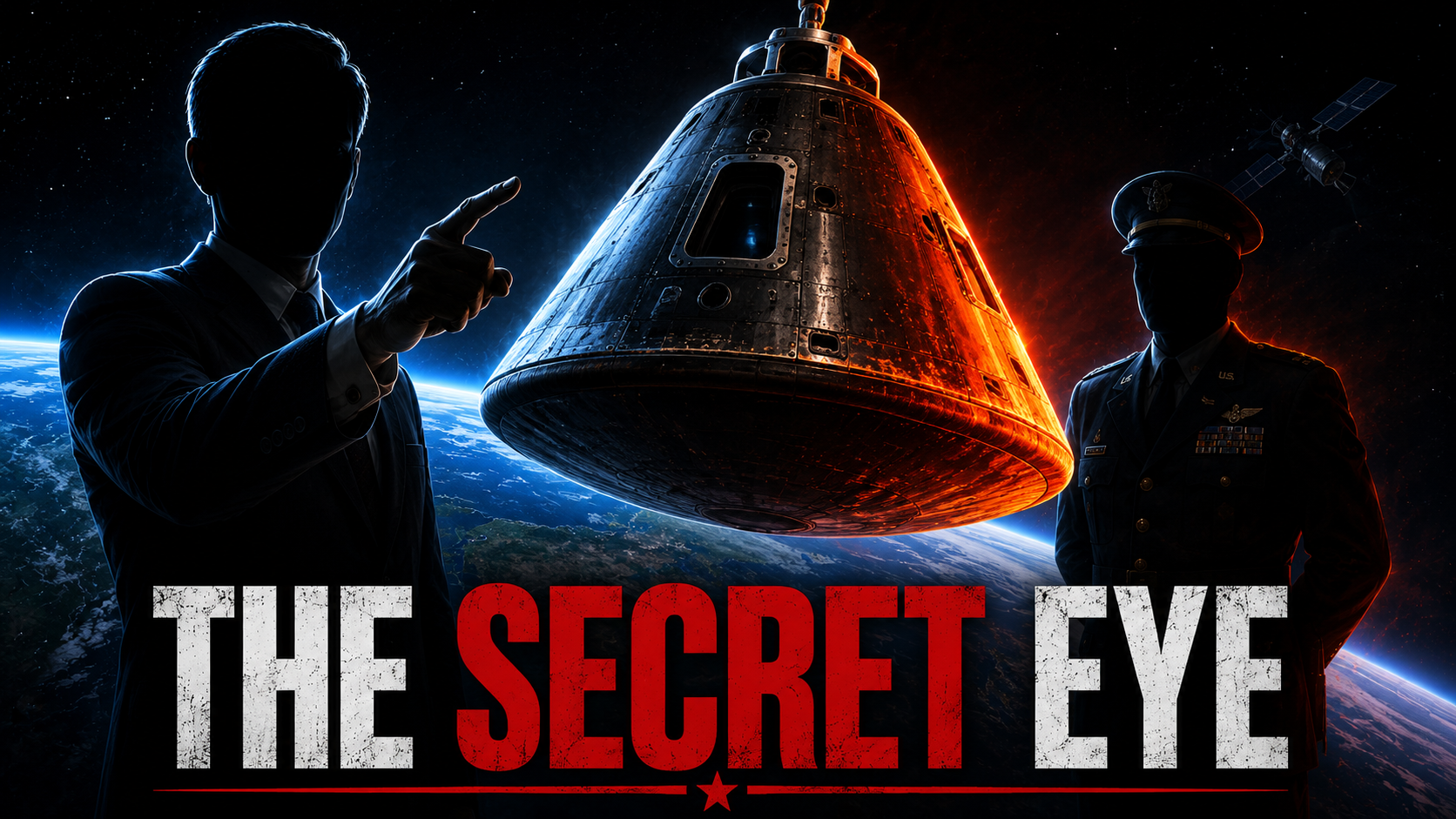
The solution to the film recovery problem was the part of the plan that bordered on the surreal. The film would be loaded into a special reentry capsule a hardened, heat-shielded canister that could survive the temperatures of reentry.
That capsule would be ejected from the satellite in orbit, fall through the atmosphere, deploy a parachute, and then as it drifted down over the Pacific be physically caught in mid-air by a specially equipped aircraft trailing a hook and trapeze system. If the aircraft missed, a ship below would attempt sea recovery. The entire plan read like something from a science fiction novel. In 1958, it was simply engineering extraordinarily difficult, never-before-attempted engineering, but engineering nonetheless.
The program was hidden in plain sight under the cover name Discoverer a series of supposedly scientific satellites studying cosmic radiation and testing recovery systems. Newspapers reported on the Discoverer launches. Scientists discussed them at conferences. Nobody, outside a very small circle of cleared officials, suspected that the real mission had nothing to do with cosmic radiation.
Then they started launching. And they started failing. The first launch in January 1959 failure. The second failure. Rockets exploded on the pad. Upper stages failed to separate. Satellites tumbled out of control. Film capsules deployed prematurely and burned up. One capsule splashed down in the ocean and sank before any recovery vessel could reach it.
There were rumors that a Soviet fishing vessel in the recovery zone retrieved one capsule a rumor that haunts the program’s history to this day. By the summer of 1960, CORONA had attempted twelve missions. Twelve times, the program had produced nothing but wreckage, empty ocean, and mounting cost.
The pressure to cancel was enormous. Critics within the government questioned whether a satellite-based reconnaissance system was even technically achievable. The CIA and Air Force pushed back. The engineers, who had learned something from every failure, insisted they were close. And they were right.
On August 10th, 1960 nine days after Francis Gary Powers was paraded before Soviet cameras in Moscow Discoverer 13 launched from Vandenberg Air Force Base in California. It carried no camera. It was a pure test of the recovery system. When the capsule separated from the satellite and fell toward Earth, when the parachute deployed cleanly over the Pacific, when a C-119 aircraft flying a precisely calculated intercept course extended its trapeze hook and snared the parachute shroud lines at twelve thousand feet — for the first time in human history, an object had been successfully recovered from orbit. The engineers wept. The generals called Washington. History, quiet and classified, had been made.
Eight days later, Discoverer 14 carried a real camera and real film into orbit. It circled the Earth seventeen times. Its panoramic camera swept back and forth across Soviet territory over Siberia, over Kazakhstan, over the vast military-industrial regions that American analysts had been trying to see for a decade. When the film capsule was caught by another C-119 over the Pacific and rushed to a processing facility, the analysts who spread those photographs across their light tables found themselves looking at more imagery of the Soviet Union than had been collected by all the U-2 flights in the program’s entire history. Combined.
What they found demolished the missile gap. The Soviet Union did not have thousands of missiles. It had dozens far fewer than the terrifying estimates that had been driving American defense policy for years. The launch sites were there, photographable, countable, mappable.
The feared massive Soviet strategic advantage was a ghost a product of incomplete information, worst-case analysis, and the particular paranoia of an era defined by nuclear fear. America was not behind. The evidence, now irrefutable and photographic, showed something close to strategic parity. The fear that had shaped budgets, elections, and military doctrine for five years dissolved in the face of pictures taken from one hundred miles up.
CORONA did not stop with Discoverer 14. The program continued for twelve more years, launching 145 missions, continuously improving its cameras, its film systems, its recovery procedures. Each successive generation of CORONA satellites produced sharper, more detailed imagery. Analysts could eventually identify individual aircraft on Soviet airfields, count vehicles in military motor pools, track the construction of new missile silos in real time.
By the time the program was officially concluded in May 1972, it had photographed more than 750,000 square miles of Soviet territory and produced hundreds of thousands of individual images. It had watched the Cuban Missile Crisis from orbit providing the context in which American decision-makers could understand what the aerial photography of Cuba actually meant. It had tracked Soviet naval buildups, monitored nuclear test sites, and provided the continuous, reliable intelligence foundation on which American strategic planning rested for an entire decade.
And through all of it, the engineers who built it could not tell their families what they had done. The pilots who caught film canisters from the sky went home and said nothing. The analysts who read the photographs who knew, years before the public, that the missile gap was a myth carried that knowledge in silence. The classification held completely. For thirty-five years.
It was President Bill Clinton who finally opened the archive. In February 1995, he signed the executive order declassifying the CORONA program. The original imagery was transferred to the United States Geological Survey and made available to researchers, historians, and the public. The engineers who had built the impossible thing were finally allowed to speak. Some of them were in their seventies and eighties by then. Some had spent their entire careers without once being able to tell anyone what they had actually accomplished.
The story they told the story that had been waiting thirty-five years to be heard was about more than satellites and cameras and Cold War intelligence. It was about what happens when a problem is truly frightening, when the conventional solutions have failed, and when a small group of people decides to attempt something that has never been done before. Twelve failures. Twelve. And they kept going. Because the alternative remaining blind while the most dangerous military competition in human history played out above the clouds was simply not acceptable.
CORONA changed what space meant. Before it, orbit was a frontier symbolic, aspirational, a race for prestige between competing superpowers. After CORONA, orbit was a tool. A platform from which the truth could be seen, documented, and acted upon. Every reconnaissance satellite that passes silently overhead today, every intelligence-gathering system in low Earth orbit, every image taken from space that influences a military decision or a diplomatic negotiation traces its lineage directly to a program that officially did not exist, run by people who were officially not allowed to discuss it, that failed twelve times before it succeeded.
The photograph exists. The archive is open now. And the truth it showed the truth that the Soviet threat, while real, was not the apocalyptic, overwhelming force that nightmares had made it is available to anyone who wants to look. It was there all along. A hundred miles up, in the dark, circling silently above a terrified world, the camera was watching. And what it saw, finally, after thirty-five years, we are allowed to know.