
Operation Neptune Spear: The Night America Violated Pakistan’s Sovereignty
On the night of May 1st, 2011, four American helicopters crossed the border between Afghanistan and Pakistan at low altitude,…
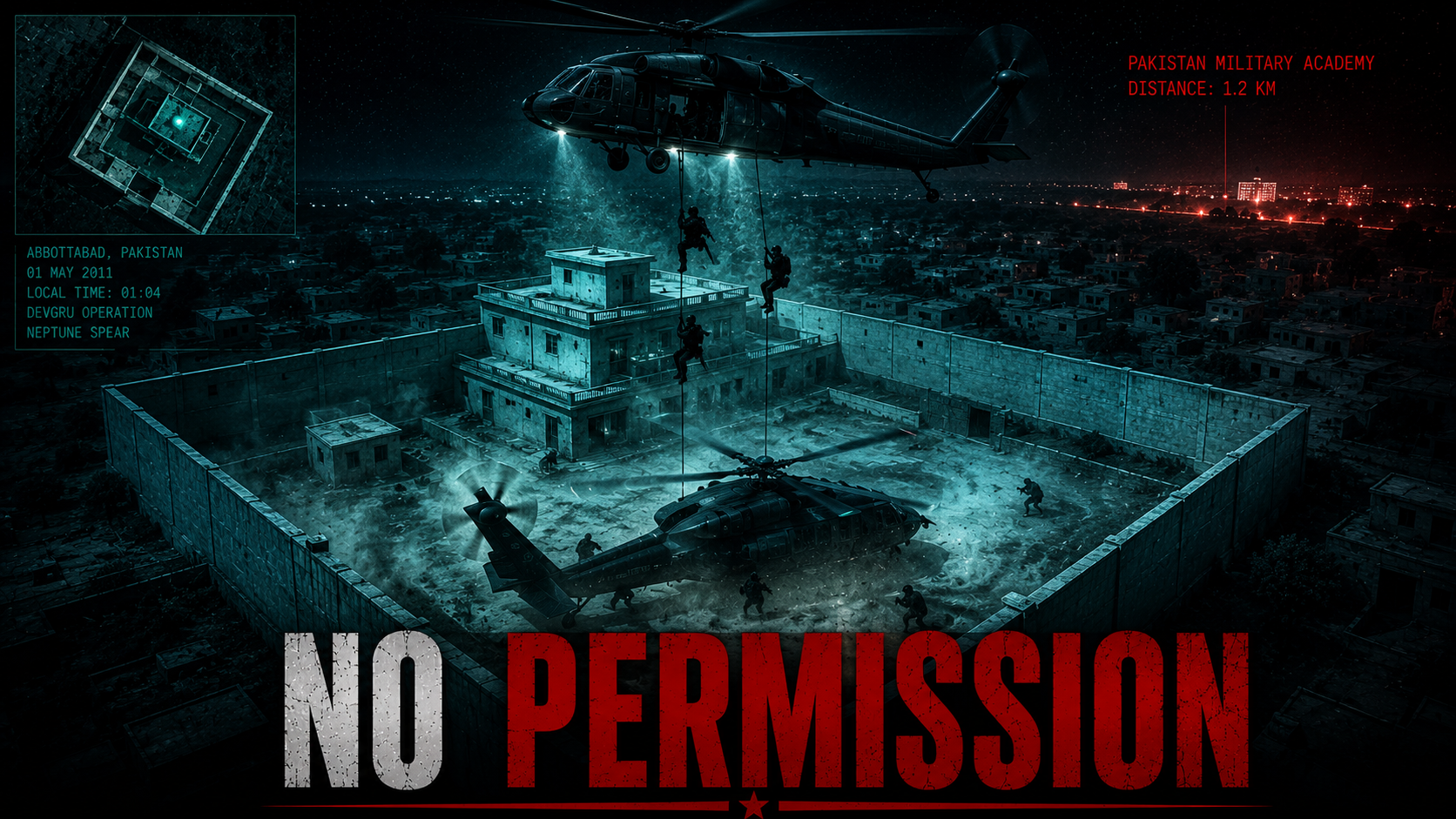
On the night of May 1st, 2011, four American helicopters crossed the border between Afghanistan and Pakistan at low altitude, running dark, without transponders, without communication to Pakistani air traffic control, without notification to Pakistani military command, without any form of diplomatic authorization from a sovereign nation whose airspace they were about to spend the next ninety minutes occupying.
Pakistan’s air defense radar among the most sensitive in South Asia, a system maintained with American funding and American technical assistance did not detect them. The helicopters flew for ninety miles into Pakistani territory. They descended on a residential compound in the military garrison city of Abbottabad. And in the thirty-eight minutes that followed, the longest and most expensive manhunt in American history came to an end.
Pakistan found out the same way the rest of the world did. From the news.
What happened that night not just inside the compound walls but in the relationship between two nations that had been nominally allied for a decade is one of the most diplomatically complex and least publicly examined dimensions of Operation Neptune Spear. America violated Pakistani sovereignty in the most direct way imaginable: it sent uniformed military personnel into Pakistani territory to conduct a kill mission, without asking, without telling, and without any intention of seeking permission it was certain would not be granted. And Pakistan which possessed nuclear weapons, which hosted American supply lines into Afghanistan, which had received billions of dollars in American military aid said almost nothing. Because saying something would have required explaining things that Pakistan could not explain.
To understand how this became possible, you have to understand the intelligence operation that preceded the raid by years. The hunt for Osama bin Laden had been the defining obsession of American intelligence since September 12th, 2001. At its peak, the CIA’s Counterterrorism Center had hundreds of analysts working on nothing else. The NSA dedicated extraordinary signals intelligence resources to the problem.
Human intelligence networks across South Asia were oriented toward a single question. And for years despite all of this, despite the full weight of the most powerful intelligence apparatus ever assembled the answer was nothing. Bin Laden had disappeared into a world of couriers and cutouts, face-to-face communication and hand-delivered messages, a deliberate and comprehensive abandonment of any electronic communication that American signals intelligence could intercept.
The breakthrough, when it came, came from the most traditional of intelligence sources: a name. In the mid-2000s, a detainee in American custody the precise identity and circumstances remain disputed across multiple accounts provided, under interrogation, the nom de guerre of a courier. A man known as Abu Ahmed al-Kuwaiti, who was believed to be one of a small number of trusted individuals who maintained direct communication with bin Laden’s inner circle. The name went into the analytical system. It was cross-referenced, tracked, searched for across every intelligence stream. And for years it produced nothing because al-Kuwaiti, like his principal, was extraordinarily careful.
Then, in 2010, the NSA intercepted a phone call. Al-Kuwaiti, speaking on a phone he had apparently allowed himself to use for a moment of carelessness, made a call that placed him in Pakistan. The call was brief. The content was innocuous. But the signals intelligence was enough to begin physical surveillance. CIA assets in Pakistan began tracking the courier. The tracking led to Abbottabad. The surveillance of Abbottabad led to a compound a large, unusually secure structure in a residential neighborhood of a city whose primary distinction was that it housed the Pakistan Military Academy, Pakistan’s equivalent of West Point.
The compound had walls twelve feet high. It burned its own trash rather than leaving it for collection. It had no telephone lines, no internet connection. The residents never appeared in public. The compound had been built in 2005, four years after September 11th, at a cost that significantly exceeded what the neighborhood’s property values would suggest was normal. And one of its residents a tall man whose identity could not be confirmed from the surveillance footage available paced the compound’s internal courtyard for exercise, never leaving, never being visible from outside the walls. The CIA called him the Pacer.
The analytical process that followed the identification of the Abbottabad compound was, by every account, one of the most rigorous and most contested in the agency’s history. Analysts were asked to assess the probability that the Pacer was bin Laden. The assessments ranged from forty percent to ninety-five percent, depending on the methodology and the analyst. Director of National Intelligence James Clapper put the probability at around sixty percent.
CIA Director Leon Panetta was more confident. The uncertainty was irreducible there was no way to confirm the identification without either entering the compound or taking an action that would reveal American surveillance of it. The President was presented with four options: a drone strike on the compound, a joint operation with Pakistani forces, a B-2 bomber strike that would destroy the compound entirely, and a helicopter raid by special operations forces. Obama chose the raid. He wanted a body. He wanted certainty. A drone strike or bombing run would leave nothing that could be definitively identified.
The preparation for the raid was conducted in extraordinary secrecy and in extraordinary detail. A replica of the Abbottabad compound was constructed at a classified location and used for rehearsals over several weeks. SEAL Team 6 operators practiced the assault until every movement was automatic. The mission was rehearsed in daylight and in darkness, in full kit and with every scenario including catastrophic helicopter failure built into the planning.
The aircraft chosen for the mission included at least two helicopters that have never been officially acknowledged modified Black Hawks with stealth features that reduced their radar signature and acoustic profile, aircraft whose existence was unknown outside the classified aviation community until one of them crashed in the compound courtyard and Pakistani engineers got a close look at the wreckage.
Pakistan was not informed. This decision made at the highest levels of the Obama administration was based on a cold intelligence assessment that had accumulated over a decade of difficult experience. American intelligence officials had concluded, with varying degrees of certainty and varying degrees of documentation, that elements of Pakistan’s intelligence service the ISI had at minimum tolerated and at maximum actively facilitated the presence of Al-Qaeda operatives in Pakistani territory.
The specific question of whether Pakistani officials knew that bin Laden was living in Abbottabad in a compound a thousand meters from the entrance to the Pakistan Military Academy has never been definitively answered. The Obama administration’s position was that it could not be answered with sufficient certainty to risk informing Pakistani authorities and losing the target. If the ISI knew and had been protecting bin Laden, notifying Pakistan of the raid would have been operationally suicidal.
So the helicopters flew in the dark without asking. The raid itself was not the clean thirty-eight minute operation that early public accounts suggested. The first helicopter one of the classified stealth Black Hawks lost lift in the compound’s high-walled courtyard, a phenomenon that pilots and engineers later attributed to the interaction between the rotor wash and the compound’s walls in the warm Pakistani night air. The helicopter came down hard against the compound wall and was disabled.
The crew was unhurt. The mission continued. Breachers moved through the compound methodically, floor by floor. Bin Laden was found on the third floor of the main building. He was shot twice once in the chest, once above the left eye and killed. His body was identified by multiple operators, photographed extensively, and transported aboard the extraction helicopters. The disabled stealth helicopter was destroyed by explosive charges before departure but not completely enough to prevent Pakistani military engineers from examining and photographing the wreckage in the hours that followed.
The thirty-eight minutes of assault were followed by what may have been the most tense period of the entire operation: the flight back to Afghanistan. The helicopters crossed back into Afghan airspace with Pakistani radar now active and Pakistani Air Force jets scrambled to investigate the reports of unidentified helicopters in Abbottabad. The extraction aircraft were airborne and moving fast.
Pakistani jets, whatever their orders, did not intercept. The helicopters landed at Jalalabad Air Base in Afghanistan. Obama, who had been watching a live drone feed of the compound with senior national security officials in the White House Situation Room, received the confirmation he had been waiting for: the mission was complete. The target was confirmed.
The diplomatic aftermath began within hours. Pakistan’s military and intelligence leadership were furious or performed fury with sufficient conviction that the distinction was practically meaningless. The ISI and the Pakistani Army, both of which had significant institutional reasons to be embarrassed by the raid’s success, framed their response around sovereignty: America had violated Pakistani territorial integrity, had conducted a military operation on Pakistani soil without authorization, had treated Pakistan as a failed state rather than an ally.
The civilian government of President Asif Ali Zardari found itself in the nearly impossible position of having to simultaneously condemn the sovereignty violation for domestic audiences and acknowledge, privately and to American interlocutors, that the outcome the death of the man who had ordered the September 11th attacks was not entirely unwelcome.
The question that Pakistan could not answer publicly was the one that defined its diplomatic paralysis: if Pakistan’s sovereignty had been violated, why had its air defenses not responded? Why had its military not scrambled jets in time to intercept the American helicopters on their inbound flight? The answer that Pakistani radar had simply not detected the aircraft, whether through the stealth modifications or through gaps in radar coverage along the specific flight corridor used was deeply embarrassing for a military that presented itself as a regional power with sophisticated air defense capabilities.
Acknowledging the failure meant acknowledging the vulnerability. And acknowledging the vulnerability meant acknowledging that the American helicopters had come and gone through Pakistani airspace in a way that Pakistani military capability had been unable to prevent.
The wreckage of the crashed stealth helicopter was examined by Pakistani authorities and photographed by journalists before American officials could arrange for its return. The photographs that circulated showed tail rotor assembly components that aviation experts immediately recognized as unlike any publicly acknowledged Black Hawk variant hub fairings, blade geometry, and acoustic treatment materials that indicated a classified stealth modification program of significant sophistication.
The Chinese government formally requested access to the wreckage for examination. Pakistan which has significant military and intelligence cooperation with China did not immediately decline the request. The United States urgently and in the strongest diplomatic terms requested that Pakistan return the wreckage without allowing third-party examination. Pakistan eventually complied. Whether the examination occurred before compliance was never definitively established.
The body of Osama bin Laden was transported to the USS Carl Vinson in the North Arabian Sea. He was washed, wrapped in a white sheet in accordance with Islamic burial tradition, and buried at sea dropped from the carrier’s flight deck into the ocean at a location that has never been publicly disclosed. The decision to bury at sea was made to prevent any grave site from becoming a shrine or a rallying point. The decision also ensured that no physical remains were available for independent identification.
The only evidence that bin Laden was dead was the American government’s word, the photographic documentation that the Obama administration chose not to release publicly, and the DNA analysis that matched samples taken from the body to reference material collected from bin Laden’s biological family. The photographs of the body have never been made public. They remain classified.
The relationship between the United States and Pakistan survived Operation Neptune Spear because neither side could afford the alternative. American supply lines into Afghanistan ran through Pakistani territory. American counterterrorism operations in the tribal regions of Pakistan’s northwest depended on degrees of Pakistani cooperation, however grudging and imperfect, that would have been impossible to replace.
Pakistani financial and military dependency on American assistance was substantial enough that a formal rupture would have been economically and strategically damaging to Islamabad. The alliance continued damaged, distrustful, transactional, and deeply uncomfortable for both parties, but continued.
What Neptune Spear established as doctrine, as precedent, as a statement about how America would conduct the most sensitive of its security operations was this: that when the intelligence was compelling enough and the stakes were high enough, the constraints of allied sovereignty were negotiable. Not in public.
Not in any document that would survive a FOIA request. Not in any statement that any official would make on the record. But in practice, in the dark, at low altitude without transponders, American power would go where American power decided it needed to go. And the countries it flew over would make their calculations about what they could and could not say about it. Because some violations of sovereignty come wrapped in outcomes that the violated party cannot publicly wish had gone differently.
Pakistan knew this. America knew Pakistan knew. And in the careful, dishonest, mutually necessary diplomatic performance that followed, both sides said what their domestic audiences required them to say and did what their strategic interests required them to do. The helicopters had come and gone. The man was dead. And the night that America violated Pakistani sovereignty without asking became, in the diplomatic vocabulary of the relationship, something that was acknowledged without being acknowledged, protested without being protested, and filed along with so many other difficult truths of the alliance in the category of things that both parties had agreed, for reasons of mutual convenience, to never fully discuss.



One Comment