Operation GOLD: How the CIA Dug the Most Brilliant Spy Tunnel in History Into a Trap the KGB Had Already Set
Somewhere beneath the rubble and ruin of a divided city, in the coldest years of the Cold War, two hundred…
Somewhere beneath the rubble and ruin of a divided city, in the coldest years of the Cold War, two hundred American and British intelligence officers are digging. They are digging in secret, beneath a city split in two by ideology and concrete and barbed wire, toward three buried telephone cables that carry the most sensitive military communications of the Soviet empire.
They have planned this for years. They have rehearsed every detail. They have built a cover story so elaborate that the operation’s entry point a warehouse in the American sector of West Berlin has been sitting in plain sight for months, its construction explained to curious neighbors as a radar installation. They believe they are about to pull off the most audacious intelligence operation in the history of the Cold War.
They are right. It is audacious. It is brilliant. It is meticulously executed. And it has already been betrayed.
To understand Operation GOLD, you have to understand Berlin in the early 1950s. The city had been divided since 1945 split between the Western Allied sectors and the Soviet sector, a living geography of the Cold War’s central contradiction. Four miles separated the American sector from the Soviet military headquarters at Karlshorst, where the communications cables of the Red Army’s entire European command ran beneath the streets.
Those cables carried telephone conversations, teletype messages, and encrypted communications between Soviet military commanders across Eastern Europe and their superiors in Moscow. For the CIA and MI6, those cables represented something almost unimaginable a direct window into the operational communications of the Soviet military, in real time, unfiltered, spoken in the assumption of complete privacy.
The plan that emerged from the joint CIA-MI6 planning sessions of 1953 and 1954 was staggering in its ambition. They would dig a tunnel 1,476 feet long, running from a building in the American sector of West Berlin, crossing beneath the sector boundary, and reaching up to the Soviet cables buried eighteen inches below the surface of Schönefelder Chaussee in the Soviet sector. At the tunnel’s end, they would install tapping equipment amplifiers, recorders, the most sophisticated signals intelligence hardware of the era and begin intercepting every communication that passed through those cables.
The tunnel would have to be dug in complete secrecy, its soil disposed of without detection, its construction vibration damped to prevent Soviet sensor equipment from detecting underground work. The entire operation planning, construction, and the eventual intelligence harvest was given the codename GOLD on the American side and SILVER on the British side.
The cover story was a masterpiece of deception. In 1954, a building was constructed in the American sector at the corner of Rudow apparently an Army radar installation, its purpose explained by the large antenna arrays mounted on the roof. Neighbors accepted the explanation. Soviet intelligence noted the construction but assessed it as routine military infrastructure. Inside, beneath the building’s floor, work on the tunnel began in September 1954.
The engineering was extraordinary. The tunnel had to be excavated through sandy Berlin soil without causing surface subsidence that might be noticed by East German or Soviet observers above. The excavated soil thousands of tons of it over the construction period had to be disposed of silently, transported away in bags and containers, mixed with other material, spread across locations where it would not attract attention.
The tunnel itself was lined with steel prefabricated sections brought into the building in pieces, assembled underground, bolted together to form a structure capable of supporting the weight of the street above. Air conditioning and dehumidification systems were installed to protect the electronic equipment from Berlin’s variable climate. A security chamber was built at the Soviet sector end a locked room accessible only to cleared personnel, housing the actual tap equipment. Twelve hundred feet of tunnel was dug in approximately six months. By February 1955, the taps were connected to the Soviet cables. The intelligence harvest began.
What came back through those cables was extraordinary or appeared to be. Over the eleven months that the tap was operational, more than forty thousand hours of telephone conversations were recorded. Hundreds of thousands of teletype messages were intercepted. The material covered Soviet military order of battle across Eastern Europe, troop deployments, logistics planning, command relationships, weapons systems, personnel movements. Analysts in Washington and London worked in shifts around the clock processing the material. It was, by every measure that intelligence professionals apply to such things, the most productive single source operation either agency had ever run. And it had been compromised before the first shovel broke ground.
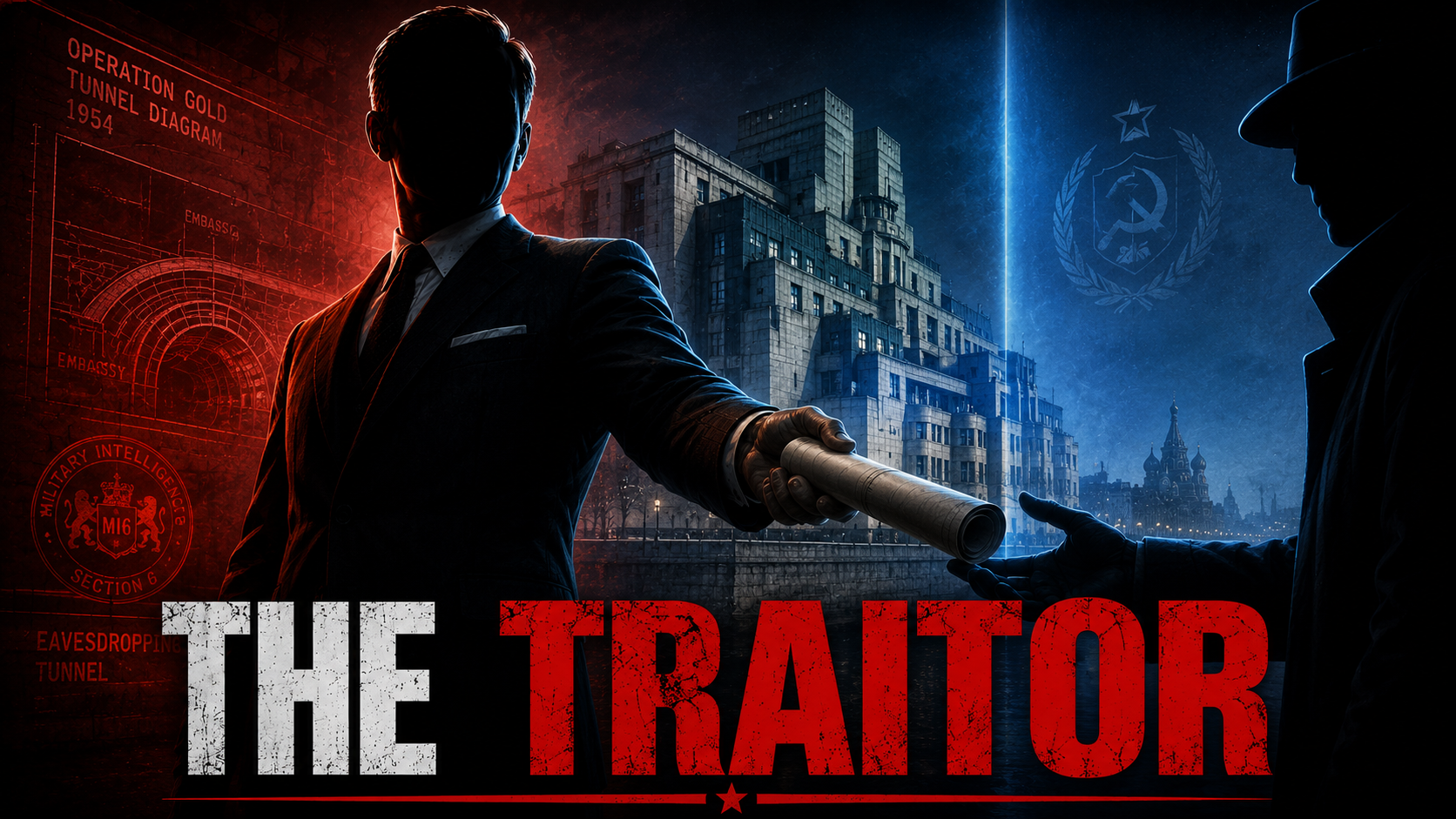
In January 1954, a joint CIA-MI6 planning conference had been held in London to finalize the operational details of GOLD. Present at that conference was a senior MI6 officer named George Blake. Blake was brilliant, trusted, highly cleared, and one of the KGB’s most valuable agents inside British intelligence. He had been recruited by Soviet intelligence during his captivity in Korea in 1951 a fact that neither MI6 nor the CIA had any idea about. Within days of the London conference, Blake had passed the complete operational details of GOLD to his KGB handler. The Soviets knew everything. The tunnel’s planned route. Its entry point. Its target cables. Its expected completion date. They knew it all before construction began.
What the KGB did with this information is one of the most studied decisions in the history of intelligence tradecraft. The obvious response the response that any organization might reflexively choose would have been to arrest the CIA and MI6 personnel involved, expose the operation publicly, and score a significant propaganda victory in the ongoing information war of the Cold War.
But the KGB did not do this. Because doing so would have immediately raised the question of how they knew. And answering that question would have exposed George Blake one of their most valuable penetration agents inside British intelligence at a moment when his continued access was worth far more than the propaganda value of exposing a tunnel.
So they let it run. For eleven months, the KGB knew that every conversation passing through those cables was being intercepted by Western intelligence. For eleven months, Soviet and East German military personnel using those telephone lines were speaking in some cases into microphones that they knew were being listened to, conveying information that had been carefully calibrated to be useful enough to seem authentic but managed carefully enough to protect genuinely sensitive material. The intelligence harvest that CIA and MI6 analysts were processing with such excitement in Washington and London was, in significant part, a curated product real enough to maintain credibility, shaped carefully enough to serve Soviet interests.
The operation was exposed in April 1956 not through any intelligence failure on the Western side, but because the KGB finally decided that the tap had run long enough and that the operational risk of continued Western access outweighed the counterintelligence value of maintaining the deception. On April 21st, Soviet and East German personnel began excavating toward the tunnel from the Soviet sector side, ostensibly investigating a suspected fault in the telephone cables.
They broke through into the tunnel on April 22nd. The discovery was treated as a complete surprise Soviet officers expressing theatrical shock at the audacity of the Western operation. Press photographers were brought in. The tunnel was presented to the world as evidence of American and British espionage aggression. Khrushchev made speeches. East German officials gave tours. The propaganda value, delayed eleven months from its maximum potential impact, was harvested at a moment the Soviets chose.
What happened to George Blake is a story that takes longer to tell than the tunnel itself. He continued working for MI6 and for the KGB for five more years after GOLD was exposed. He was not identified until 1961, when a Polish defector provided information that led investigators to him. He was arrested, tried under the Official Secrets Act, and sentenced to forty-two years in prison the longest sentence ever handed down by a British court at that time.
The judge reportedly said that the enormity of his crimes put them in a different category from ordinary espionage. In 1966, Blake escaped from Wormwood Scrubs prison with the help of a peace activist, a rope ladder, and a getaway car. He made his way to East Germany, was received as a hero by the KGB, and lived in Moscow until his death in 2020, at the age of ninety-eight, receiving Soviet and Russian state honors until the end.
The question that Operation GOLD leaves behind is one that intelligence professionals have argued about ever since. Was the operation a failure or a success? The answer is genuinely complicated. The eleven months of intercepted communications, even filtered through Soviet counterintelligence management, produced real intelligence value material that analysts could cross-reference, verify, and use. The mere existence of the tap forced Soviet communications security to become significantly more sophisticated.
The operational and engineering achievement of the tunnel itself regardless of its ultimate compromise demonstrated a level of technical ambition and execution that shaped Western intelligence methodology for decades. CIA Director Allen Dulles, when the tunnel was exposed, called it one of the most daring and valuable intelligence operations ever conducted. He was not entirely wrong, even knowing what he eventually came to know about Blake.
But the deeper truth is harder to celebrate. The most brilliant spy tunnel in history was dug, at extraordinary cost and risk, into a trap that the enemy had constructed and maintained with equal brilliance. Every shovel of Berlin clay that was moved, every steel section that was bolted together, every reel of tape that was filled with intercepted Soviet conversations all of it happened inside a frame that the KGB had built and controlled from the beginning. The audacity that Western intelligence brought to the operation was matched, precisely and invisibly, by the audacity of the counterintelligence operation that contained it.
Berlin in the 1950s was the most concentrated espionage environment in human history. In its divided streets, beneath its divided ground, the intelligence services of the most powerful nations on Earth were playing a game whose rules kept changing, whose stakes were nuclear, and whose deepest moves were visible only in retrospect. Operation GOLD was one of those moves brilliant on its surface, hollow at its core, and fully understood only when the man who had betrayed it walked out of a British prison through a hole in the wall and disappeared east forever.
The tunnel is still there. Sealed now, beneath a Berlin that reunified without it. But it is still there 1,476 feet of Cold War audacity, running silently under streets that no longer divide anything, toward cables that no longer carry the secrets of an empire that no longer exists. A monument to the extraordinary and the futile, built by people who believed they were outsmarting the enemy and discovered, too late, that the enemy had been watching them dig from the very first day.